A wastewater plant needs to isolate a screen channel for maintenance. Another facility needs to maintain an upstream basin level. Both applications involve water-control gates, but they call for different equipment—and different operating plans.
Choosing by opening size or a familiar product name can overlook what determines performance: hydraulic head, sealing direction, operating frequency, mounting conditions and maintenance access. The better starting point is simple: what must this gate accomplish, and how will the plant operate it?
Slide and Sluice Gates: Isolation with Operating Flexibility
Slide gates and sluice gates use a moving panel, or slide, guided within a frame to open or close a waterway. The terms often overlap in specifications and legacy facilities. Define construction and service requirements rather than assuming the name identifies the design.
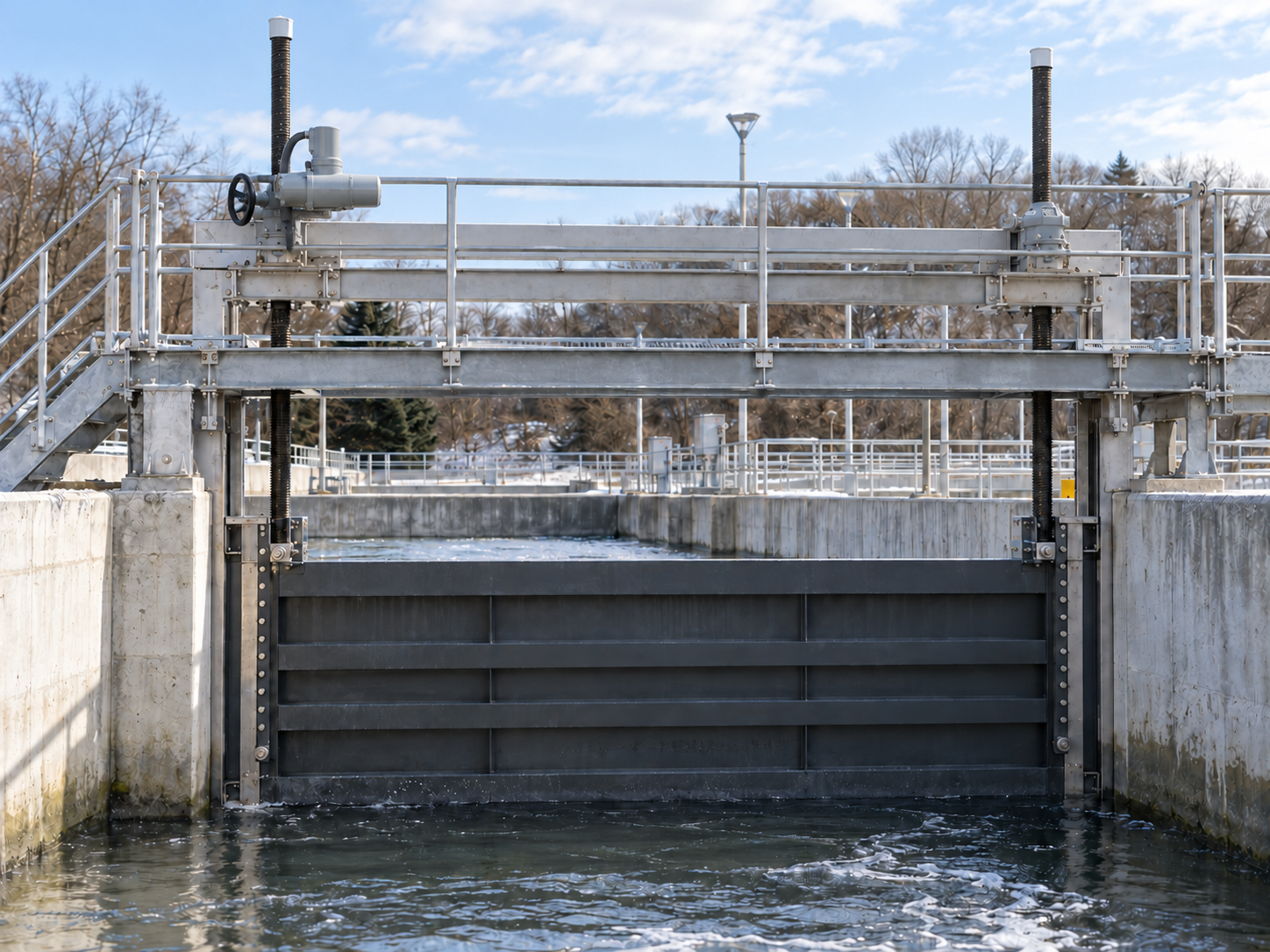
These gates serve headworks, pump stations, treatment basins, intakes and industrial water systems. A submerged opening commonly requires sealing around all four sides. An open-channel gate typically seals along the sides and bottom, allowing overflow if water rises above the slide.
Manual operators are suitable for easily accessible gates that are used infrequently. Electric actuators support remote operation and automated sequencing. Pneumatic or hydraulic arrangements may suit applications with appropriate utilities and operating requirements. For throttling, confirm that the gate and operator are designed for positioning duty; an isolation gate is not automatically a suitable control gate.
Weir Gates: Control the Overflow Elevation
A downward-opening weir gate lowers to create an adjustable overflow crest. Moving that crest changes the overflow elevation and helps control upstream water level. Applications include basin level control, flow splitting and treatment channels.
Selection must account for downward travel clearance, available head and downstream water levels. Submerged overflow changes hydraulic behavior, so gate position alone does not establish flow rate under every condition. Automated level control also requires a suitable level signal and control strategy.
Wide weir gates may require synchronized lifting points to keep the slide level and prevent binding. Coordinate the gate, stems, gearboxes and actuator as one assembly.
Stop Gates and Stop Logs: Plan the Handling
A stop gate is generally a removable panel installed in guides for temporary isolation or diversion. Stop logs use stacked removable sections, allowing operators to build an isolation barrier in increments.
These options are useful where isolation is infrequent and rapid closure is unnecessary—for example, taking a treatment channel out of service for planned maintenance. They can reduce permanent operating equipment, but installation and removal require a practical handling plan.
Confirm panel or section weights, lifting-device capacity, guide access, storage location and required staffing. Verify allowable head during insertion and removal with the manufacturer. Equipment that seals under design head is not necessarily designed to be handled under that same differential head.
Define Head Direction and Leakage Before Ordering
Opening dimensions are only part of the selection. Establish water elevations on both sides, maximum differential head and whether the flow or head can reverse. Include abnormal conditions such as a drained basin beside a full channel.
Seating head pushes the slide toward its sealing surface; unseating head pushes it away. That distinction affects seal loading, frame design, operating effort and leakage. Where reverse head is possible, confirm the required sealing performance in both directions.
Specify allowable leakage, test head and acceptance procedure. Avoid relying on broad descriptions such as “watertight.” AWWA C560 addresses cast-iron slide gates, while C561 addresses fabricated stainless-steel slide gates; select the applicable standard and project-required edition.
Match Materials and Compliance to the Project
Select the frame, slide, stem, seals and sliding surfaces for the actual water chemistry, solids, temperature and exposure. Stainless steel is common in municipal service, but grade and elastomer compatibility still require review, especially in industrial wastewater.
For drinking-water applications, confirm the specified NSF/ANSI/CAN 61 certification and its coverage for the proposed equipment. This standard addresses health effects from materials contacting drinking water; mechanical performance requires separate evaluation.
For funded infrastructure projects, identify applicable American Iron and Steel (AIS) and Build America, Buy America (BABA) requirements early. Verify product-specific documentation and any applicable waivers before procurement. A supplier’s location or a general domestic-origin statement does not establish project compliance.
Installation and Automation Determine Reliability
A correctly selected gate can still bind or leak if its frame is distorted against uneven concrete. Verify mounting-surface flatness, anchors, grout, thimble dimensions and alignment before installation. Keep the stem, guides and operator on the required centerline.
Size the drive from calculated operating thrust and torque, including slide weight, seal friction, stem geometry and hydraulic duty. Check stem support against compression and buckling. Specify actuator duty, travel speed, enclosure, local/remote controls, position feedback and fault signals to match plant requirements.
During commissioning, confirm free travel, limits, torque protection and position indication. If torque trips develop, investigate debris, alignment and mechanical resistance before increasing settings. Establish routine cleaning, exercising and inspections; follow lubrication instructions for the specific gate configuration.
Key Takeaways
- Choose slide or sluice gates for engineered isolation and suitable flow-control duties.
- Use downward-opening weir gates for adjustable overflow and upstream level control.
- Consider stop gates and stop logs for planned isolation with workable lifting and storage arrangements.
- Define head direction, leakage, materials and compliance before procurement.
- Treat mounting, stems, actuation and maintenance as parts of one system.
Raritan Valve & Automation helps engineers, operators and contractors across New Jersey, eastern Pennsylvania, New York City, Long Island and the surrounding New York area coordinate gate selection, submittals and automation requirements.
For support with valve selection or specifications contact RVA today Call Us or Email Us.
RVA Gates & Operators Resource Guide